
In celebration of Family History Month (October 2026), we are offering a fun activity centered around connection on the 2nd floor of the library. You can “Make Your Own or Your Family’s Coat of Arms.” This activity will run throughout October.

This article is from the “Relatively Speaking” Genealogy E-news. Sign up for tips for genealogists and in-depth information on library resources and programs.
Cemetery Symbolism
October 2026 | By Shannan E.
In 2020 I gave a presentation on cemetery symbolism that is especially fitting for this year’s spooky season. The majority of the photos and research focused on the Forest Home Cemetery located in Forest Park, IL during my time volunteering for the Forest Park Historical Society. Below are the highlights of this presentation.
The first thing to note when talking about cemeteries is general record keeping practices. These will help you in the long term, especially if you are not able to easily access the cemetery in the future.
- Photograph the cemetery entrance and sign.
- Record the gravestones nearby. This is often family, which will give you even more information.
- Take a photograph of the gravestone: The recommended time is mid-morning. You can also angle lighting onto the gravestone. This can be done with a mirror, or foil. Also wetting the stone then letting it dry for long enough that the actual surface is dry, but the indentation for the carving is still wet (63 Gaylord Cooper).
- Sometimes it is in a more forested area that doesn’t get enough sunlight. I have had some good experiences using a photo editing tool to brighten and add contrast.
- While you likely have heard of grave rubbing, I would recommend not taking that option. This can cause damage to the stone.
“Just because it was written in stone, doesn’t always mean that it’s written in stone.” – Tui Snider (from Understanding Cemetery Symbols)
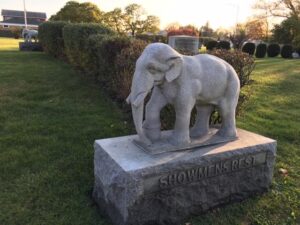
The symbol can be unique to the family or community due to context. An example is the statue for the showmen’s rest, which is located at the Woodlawn Cemetery. In 1918, 86 members of the Hagenback-Wallace Circus died when a train crashed into their train. The elephant’s meaning is directly tied to the circus and the background of those that passed.
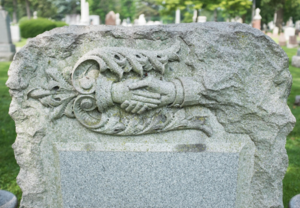
This showcases how many elements can be on a gravestone at a time. The gravestone is in the shape of a log, but it also contains a bird, handshake, wreath, oak leaves and a lily.
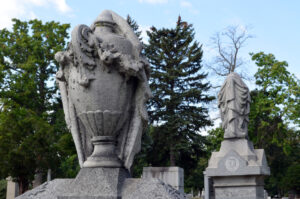
Structures
The structures of the gravestone can also have symbolism, not just the carvings.
Obelisk – Resurgence in interest in Egyptian culture in the 19th century. And often viewed as a ray of sunshine.
Draping – This can be found on both urns and obelisks. It represents the “veil between earth and heaven.”
Urn – This is a Greek symbol. The urn being the vessel for the ashes of the dead. Since cremation was a common method in ancient Greece.
Arch – Gateway. Column – Especially a broken one, is viewed as a life cut short. And it is usually done for the head of a household as the structure that kept the family together or the saying “pillar of the community”.
Cylindrical – Can represent a pillow, which represents their final resting place. NATURE Nature is a very common theme.
Oak leaf/acorn – Much of the oak leaf symbolism comes from the potential of the acorn. While the acorn is diminutive in size, it has the potential to grow into a majestic, and towering oak tree with time. It is a seed that represents the possibility of growth, as well as abundance.
Calla Lily – Represents beauty and marriage. And purity if you have heard the phrase “lily white reputation.” In that same vein, Lilies are often used for female graves.
Wreath – Often depicted more specifically as a laurel wreath, celebrates eternal life, and thus “victory over death.” And in this case, there is a lit torch inside which also represents eternal life.
Ivy – Due to its vitality and clinging nature, represents eternal life and everlasting love. Bird – Largely equates to the soul or essence of a person.
Lambs – Are a very common symbol for children. The lamb represents innocence and gentleness. Often there is a component of the lamb as a Christian religious symbol.
Thistle – Represents earthly sorrow and it is associated with Scotland.
Wheat – Bundled together, it is really only seen on graves of elderly people. This is a symbol for a life fulfilled.
Other Common Symbols
Hands – A handshake represents a “heavenly welcome or an earthly farewell.” One distinguishing characteristic between handshakes are the sleeves, which denotes specific relationships. For example, some sleeves include traditional wedding attire. Also, if one of the hands appears to be slightly above or the other is limp and not grasping at the other hand, that can mean that they are being guided into the afterlife. Possibly by a loved one who passed before. Another hand can be pointing up, which likely means that the individual is in heaven or the afterlife.
Book – A book can have several different meanings. It can represent the human heart, which, for centuries upon centuries, was believed to be where the soul and personality of an individual resided. Also, could be that they loved to read or built their career around books (like a librarian…) It could also mean the book of life, the bible, or other religious text. In that context, you may see the title of the book carved on it or passages from the book. A closed book means a completed life, like the bundle of wheat. While an open book means a life cut short.
Scroll – Represents time. The unfolding of the scroll is the life the individual lived and also the unknown future existence in the afterlife.
Chain – Often seen them broken, which means a family link has been broken due to death.
Conclusion
There are so many more symbols and context than I could list here. I only scratched the surface. The meaning can vary based on the individual’s religion, region, fraternal alliance (ie. Brotherhood), and more. Additionally, outside of the symbols themselves, there could also be additional meaning and context around the other elements seen on a gravestone. This can include ceramic photos or the material the gravestone is made from. This might be covered in a future Genealogy newsletter.
Resources
Find a grave has numerous pictures of the gravestones within a cemetery, so you might not actually have to visit the grave sites if you are unable to due to distance or other factors. You can also scope out the area in advance using the map section. Some graves even include photos and additional records of the individual at rest at the gravesite. You can also add your own photos and information or help continue the site’s attempt to digitize all possible gravesites.
Books:
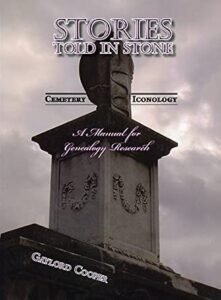
Stories Told in Stone: Cemetery Iconology: A Manual for Genealogy Research by Gaylord Cooper
This is the book I used the most for my research. I highly recommend starting with this book if you are getting started with your cemetery research. The author offers a couple of pre-made worksheets that you can take along. This will help you make note of adiditional details that you may otherwise forget.
The Family Tree Cemetery Field Guide: How To Find, Record, & Preserve Your Ancestors’ Graves by Joy Neighbors
Grave Marker Symbols: A Field Guide by Loren N. Horton And Michael D. Zahs
- Available through Inter Library Loan for Indian Trails Card Holders.
If The Stones Could Speak: A Guide To The Shapes And Symbols In Your Local Cemetery by Ryland Brown
- Available through Inter Library Loan for Indian Trails Card Holders.
Stories in Stone: A Field Guide to Cemtery Symbolism and Iconography by Douglas Keister
Tombstones Of Your Ancestors By Louis Schafer
Understanding Cemetery Symbols: A Field Guide For Historic Graveyards By Tui Snider
- Available through Inter Library Loan for Indian Trails Card Holders.
Your Guide To Cemetery Research by Sharon Carmack